Showing posts with label 2D graphics. Show all posts

Friday, 11 May 2018

NEWS: Cutesy Metroidvania Catmaze pounces onto Steam May 24th


Indie developer Redblack Spade has announced the release date for a new Metroidvania title inspired by Slavic myths. The game features cute, pixelated graphics inspired by the game’s fairy-styled world. The trailer, viewable below, details Catmaze’s own unique spin on the genre.


Players take control of sorceress Alesta in search of the lost road to Navi, the world of the dead. Accompanied by a plethora of mysterious creatures – including many adorable cats, the game seems to feature an involved story, especially thanks to the inspiration it takes from ancient Slavic myths. One of the gameplay’s main features is the summoning of familiars with unique abilities that will be able to help Alesta in her quest.  Other staples of Metroidvania games are also present, including bullet-hell style gameplay, roleplaying elements and backtracking.

Players will be able to interact with many characters on their journey, though some of the artwork may be a source for some concern. Hopefully it takes the course of cute rather than the other way this could go. Source: Redblack Spade

While Catmaze appears to be yet another indie title with a cute premise and pixelated graphics, what sets this game apart is its attention to Slavic folklore and the beauty of the game itself. Many games boast pixellated graphics, but as can be seen from the trailer Catmaze looks gorgeous, with beautiful lighting and shadow work and unique atmospheric art that immerses from a single look. On top of this, the boss encounters teased appear to be mysterious, unique and inviting. It helps that the main premise involves magical fairy cats too. 


Catmaze will pounce onto Steam on the 24th May for PC and Mac, and will be an interesting game to watch on its release thanks to its cute premise and intriguing take on Slavic myth. This cute tale looks like it could be a fun and artistic title worth a good look for fans of Metroidvania and adorable cats!

Monday, 5 February 2018

A Game To Watch: It Lurks Below

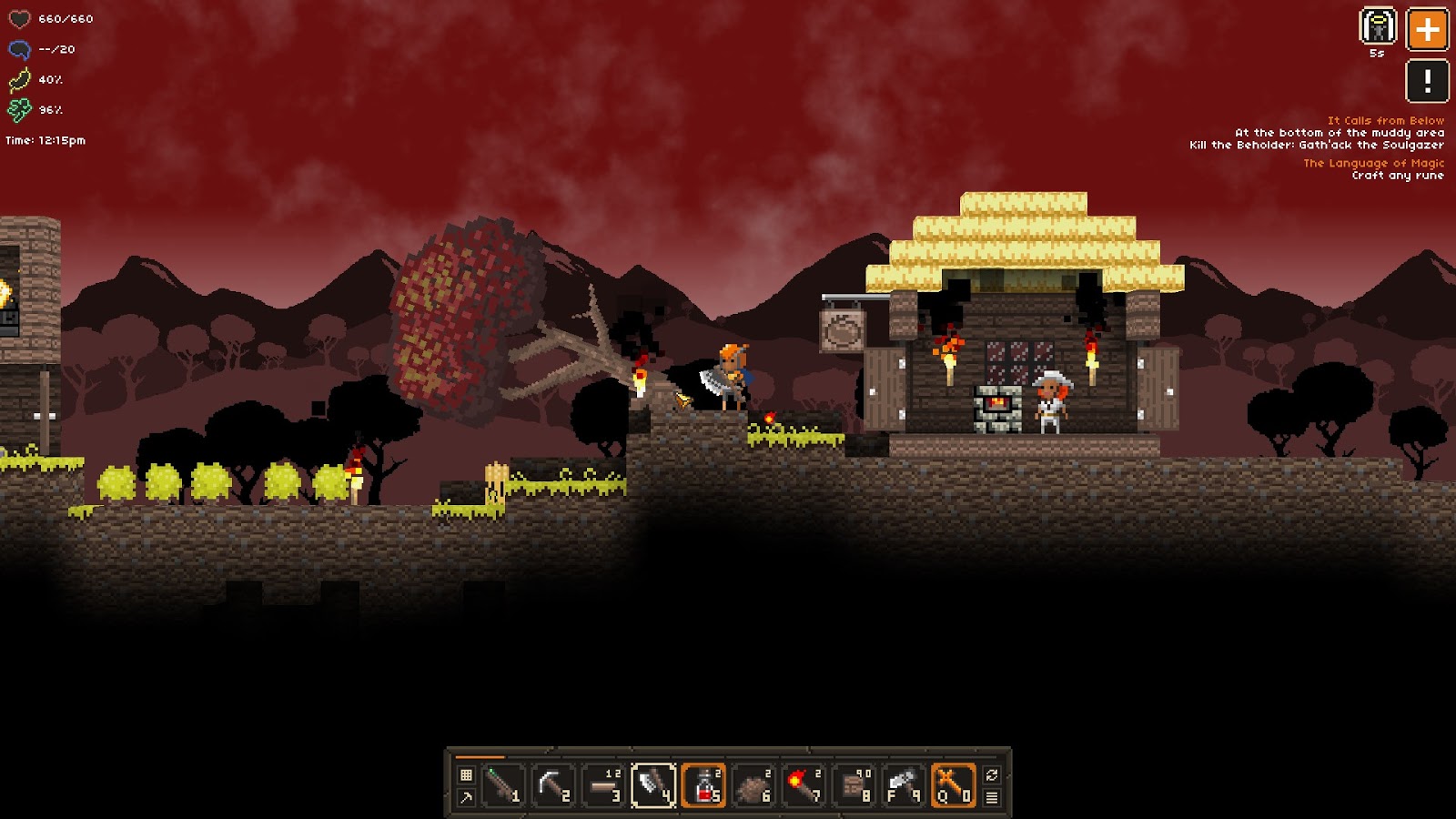
The newest game by Greybeard Games, founded by Diablo 1 and 2 creator David Brevik, is more than a little influenced by the likes of Terraria and Minecraft. Taking the form of a 2D survival game with strong action-RPG elements, the game itself is a charming and suitably dark-fantasy experience, with plenty of satisfying action and compelling, addictive gameplay.

On first glance, It Lurks Below has a lot in common with Terraria. Source: In-game screenshot.

The first thing gamers will notice upon booting up It Lurks Below and dropping into the world is its striking similiarity to the likes of Terraria and Starbound; that much is deliberate, the creator himself describes the game as a tribute to the survival genre. But soon, It Lurks Below’s unique identity begins to stamp itself on the player and they will quickly find themselves addicted to the joy of exploring ever-deeper with ever-bigger guns.

Exploring deeper is rewarding, terrifying and intriguing. Source: In-game screenshot.

There is a sense that It Lurks Below has somehow recaptured the joy of playing the survival genre in its heyday. There is something so addictive from learning the ways the game works, from crafting tools to delving down below to face off against demonic hordes. On top of an impactful combat system that is every bit as exciting as the games for which its creator is famed, It Lurks Below’s survival mechanics become intoxicating, and the player feels a sense of growing more powerful by the second, especially as they get to fire off their growing arsenal into the demons.

Another thing interesting about It Lurks Below is its graphical choices. The colour scheme of the game is undeniably demonic, with plenty of reds and browns. Its pixelated characters are reminiscent of many nostalgia-throwback survival games of Terraria’s ilk, but carries enough of its own personality to set itself apart, being in fact more 8-bit styled than 16 bit. Parallax backgrounds make an appearance, as, interestingly, do voxels; look toward the edges of blocks in It Lurks Below and you will find that they are actually rendered in 3D rather than as 2D sprites. The result is visually striking and pleasing, and does a lot to setting the game apart graphically. If only some item textures stuck out more from the drab backgrounds, as sometimes resources like tough grass can be hard to pick out and right click.
As with any survival game, chopping trees is a major part of It Lurks Below. Source: In-game screenshot.
It Lurks Below may be Terraria-like in its execution of the gameplay, but there is plenty right now to set it apart from other games wishing to cash in on the survival bandwagon. Currently, the biggest thing that stands this game out is its combat; in the game, fighting is done by magic ‘wands’ that are actually closer to guns in appearance and in use. But what is truly satisfying about laying waste to demons in It Lurks Below is the impact of the combat; every shot feels powerful and every hit landed feels strong. There is something so satisfying about the way the bullets smack against an enemy that has seldom been matched in other survival games. Diablo 1 and 2 come to mind here, as the two games brought a combat focus to an RPG genre in a way that felt fresh and visceral, and It Lurks Below attempts to do the same here.

Cutting down trees is exciting, as they now have a real felling animation, unlike many survival contemporaries. Source: In-game screenshot.


Perhaps more typical of the genre is It Lurks Below’s current status as a beta game. Currently in closed beta, it remains to be seen whether the game will open itself up as an Early Access experience or if it will go for a tighter development cycle. Either way, the game is compelling enough to be well worth playing, and will be very much worth keeping a close eye on, especially with its developer’s strong, undeniable pedigree in gaming history. It Lurks Below stands poised to bring renewal to a genre accused of being stagnant, and it is all the more important as a result.

Thursday, 11 January 2018

NEWS: Surreal Horror JRPG Yume Nikki releases on Steam for free, teases further announcement with countdown

Published by indie game specialist platform PLAYISM originally in 2007, Yume Nikki is a surreal Japanese horror experience that appears not unlike contemporaries such as Undertale and a host of RPGMaker titles. It has been re-released on Steam today for free today, January 10th, 2017.

The game’s trailer hints at the game’s surreal nature and styling, evoking familiar images of many JRPG Horror titles popular on Steam, as well as the breakout hit Undertale, especially as more of the dream-like landscapes come into prominence in the trailer. The game’s premise is stated as ‘to walk through a dream world’, and so promises surreal horror.

Interestingly, it appears as if the game itself is focused mainly on the walking and exploration aspect of JRPG horror, and doubles down on this as a game mechanic. Talking to NPCs and learning more about the game’s undoubtedly unusual plot will grant players special ‘effects’ as movement options for moving about Yume Nikki’s unusual landscape.

On top of this, PLAYISM are teasing a new announcement on Yume Nikki, directing players to a website with a countdown to the reveal, which can be found at https://promo.kadokawa.co.jp/gamecountdown/.

Developed by Kikiyama, Yume Nikki is available to download and play for free on Steam, and is available in both English and Japanese. It certainly looks to promise a unique JRPG Horror experience. PLAYISM, the game’s publisher, is also of interest: the company states that it specialises in selecting indie games based on their originality. Players interested in seeing their catalogue can find their website at http://playism-games.com/.

Saturday, 30 December 2017

A Game To Watch: They Are Billions


Developed by Numantian games, They Are Billions is an intense, brutally difficult game that entered Early Access this December. Set up as a zombie survival game, TAB is an interesting take on a saturated genre, offering a steampunk setting with real-time-strategy gameplay.
 
They Are Billions comes complete with Reticulating Splines loading menus. Screenshot from in-game.


The minute-to-minute of this game is satisfyingly difficult. Players are tasked with the construction and defence of a post-apocalyptic Steampunk-styled colony. Usual genre mainstays are in full force such as resource and unit management as well as base defences. An interesting mix of survival gameplay elements are thrown in, including food and some elementary colonist management. 

The graphics are an interesting isometric 2D style, with beautiful, smooth animation of both buildings and units, all styled in a unique way that brings out the game’s individuality. For those with hardware of the right calibre, the game art is capable of scaling to 4K graphics, as mentioned on the game’s website. 

Graphics are layered with interesting Steampunk stylings, and look crisp and unique. Screenshot from in-game.

Of most note is the AI, however. Like many zombie survival games before it, They Are Billions doubles down on the attraction of displaying massive hordes of enemies simultaneously on-screen. However, the game’s website states that a custom AI engine has been built to handle up to 20,000 units in real time. Enemies react realistically to sound and roam about the world with their own paths. When playing the game, the sheer, overwhelming force of the horde is an awe-inspiring sight, even as the swathes of undead lay waste to your base. 

Vast numbers of enemies attacking in force is a sight to behold. Screenshot from in-game.

As isometric-styled survival games go, They Are Billions holds promise not only in its style but in its brutal gameplay. The difficulty of the game itself can be tweaked by altering gameplay time and enemy numbers using sliders, but I would recommend leaving the difficulty at default to experience first hand the brutality of the horde, as it provides a visceral, if unforgiving game. 

Expect to see game-over screens a lot. This game is fiendishly brutal. Screenshot from in-game.


If you’re looking for a survival horror fix with excellent real-time strategy elements running the show, then look no further than They Are Billions, which is currently available in Early Access in Steam for just under £20. This game shows a lot of promise as a game to watch for the future.

Friday, 2 June 2017

2D And Aesthetics vs Graphics

3D graphics arguably first became mainstream with the fifth generation of gaming consoles, featuring among its lineup the Sony PlayStation and Nintendo 64. Graphics became a talking point for many games, and polygon counts a significant measurement of prowess. Pioneers of 3D gaming included Super Mario 64 and Banjo Kazooie, which brought platforming, arguably the bread and butter of any major video game console at the time, into the next generation.

With a good thirteen years since the release of the first Sony Playstation, one could have been forgiven for thinking that with 3D graphics being achievable in most modern games for so long we would have seen the death of 2D graphics. Those old days of pixels would be looked back upon with a sad nostalgia where we would wonder how we ever could make anything out on such old technology.

Of course, many gamers know that this is definitely not the case. 2D gaming stands now as a stylistic choice rather than a limitation. Indie games are always coming out with pixel-styled graphics to pull us in on the charm of nostalgia. On top of this we have all kinds of video games where the gameplay is on a 2D plane including, yes, 2D platformers.

The reason for this is because, while graphical capabilities have multiplied, so too has the artistic merit of videogame creators. We’re no longer content with ever-more photo-realistic textures but we also want our games to have an identity, to have colour and to be aesthetically pleasing. Some may even argue that we want our games to be artful. One look at how beautiful Breath of the Wild looks, despite being on under-powered hardware, tells us all we need to know about the importance of aesthetics over graphical fidelity.

With that, the use of 2D graphics has become a valid creative choice with thematic and gameplay implications that have their own useful circumstances. Most platformers haven’t really benefited from the extra dimension, and have instead resorted to the collect-a-thon style gameplay touted by Banjo Kazooie many years ago. Instead, 2.5-D games, videogames with 2D gameplay but an extra layer of 3D graphics, seem to be stylish in the platform genre. Looking at Yoshi’s Woolly World, or New Super Mario Bros., it is clear to see why such a look would be charming. The use of the graphics in these games have helped towards creating a distinct visual style.

In 2017 we have Cuphead to look forward to; an interesting 2D platformer that uses modern-console capabilities to craft an eye-popping tribute to golden age animations. The levels look like they’re pulled right out of an old Disney cartoon and look stunning in motion. It seems that choosing to craft a 2D rather than a 3D experience was vital here to achieve the exact look and feel that the developers were going for artistically, and hopefully the end result will be enjoyable to play when it comes out later this year.

Don’t Starve is another example of a game that uses 2D graphics to its vast advantage to craft a cohesive visual narrative that is striking and interesting. Here the art is meant to evoke a kind of Tim Burton storybook style, with the bold black outlines and the creature designs themselves looking like something out of an Alice-in-Wonderland book. Oxygen Not Included, Klei’s next outing, looks to be utilizing a similiar art style but with more of a utilitarian Fallout Shelter overtone.


Instead of slowly going by the wayside as 3D capabilities have continued to evolve, the use of 2D gameplay has instead become an interesting and valid creative choice in gaming that a developer can use to great positive effect for their games.

It is interesting that the 2D style still hasn’t disappeared, and I think this shows that for all the graphical bombast that the latest and greatest modern titles throw at us, what is most important is the artistic choices in developing the game, and how the end result looks. We don’t need the next big graphical powerhouse with more skin pores per inch of character skin, what we do need as gamers is aesthetic; beautifully designed games made not with lofty eye-popping graphics in mind but instead made to look beautiful on their own merit. As console power hits the point of diminishing returns with graphical fidelity, we will begin to see more focus on the aesthetic and visual design rather than the power behind the game itself.