Showing posts with label videogames. Show all posts

Monday, 18 June 2018

Dark Souls: Remastered Review


Platform played on: PC
Hours played: 80
Genre: Action-RPG
Completion: 100%

Praise the Sun

Years on from its birth, Dark Souls’ influence can still be felt at every level of gaming even today. The obscure and fiendish RPG that could has become a phenomenon, with multiple sequels and copycats hoping to tap into the formula. Though the series as we know it originated with Demon’s Souls, it was the sophomoric effort that achieved cult status. 

The Remaster of the game, released on 25/05/18, promised to refresh gamers’ memories of the cult hit, complete with modern resolution options and smooth 60fps gameplay. However, Dark Souls Remastered has proven to be controversial among consumers in the PC space, who argue that the remaster did nothing that wasn’t already done by the original game combined with the DSFix mod. Indeed, the gameplay additions in this remaster are few and far between, with the developers aiming to keep the gameplay entirely intact.

However, criticisms of the porting job specifically are just one part of the story; the central question to this review is if the game itself is good. With that in mind, specific critique on the remaster itself will come in another article. The game itself, however, should be reviewed first and foremost. With that in mind, prepare to read as we dive into the hardcore world of Dark Souls: Remastered.

Critique of the remastering job will come another time... Source: in-game screenshot


Punishing, but masterful


The most important thing that stands out about Dark Souls is the reputation of its difficulty. Souls is infamous for being a brutally-hard game that will test the resolve of even the most hardcore gamers out there. The truth is that Dark Souls has some frustrating and upsetting aspects; the game often punishes the tiniest of mistakes with swift and brutal retribution. As a result, it’s possible to lose hours of progress with just a few mistakes. 

However, it is also important to note that the player will never truly go backwards in their own development. The loss of accumulated souls (the in-game equivalent of XP and currency) makes for a painful punishment, but the player won’t lose upgrades that they’ve already made. Meanwhile, skill level will constantly improve as the mechanics of the game reveal themselves to the player. Success in Dark Souls is simply a matter of patience and perseverance.

Dark Souls may be punishing, but perseverance will be rewarded. Source: in-game screenshot

What is another important thing to note about Dark Souls is its commitment to theming and the oppressive nature of its plot. Players are tasked with journeying through the kingdom of Lordran amid an apocalypse, with the vague guidance of a grand prophecy for their motivation. Storytelling after the initial cutscene is sparse, and is primarily related to the player through NPC dialogues and item descriptions. Piecing together the lore of the world and exactly what is going on is its own rewarding meta-game in Dark Souls, and players are left to fill in the many gaps of the plot by pure speculation. 

The choice of using implication and unreliable narration to expose the plot is pure genius on the part of the developers. Dark Souls is designed through and through to be a game that players actively engage with right down to the smallest detail. The fact that the storyline is obscure lends itself to the design philosophy; that players are left to puzzle out and tease together loose plot threads by themselves creates an active atmosphere that implies a complex and convoluted world without needing the grandiose storytelling of bigger-budget games. Multiple interpretations can be made of the plot, and this only lends itself to the artistic flourish of Souls. This creates a sense of player agency and immersion; the player exists in this world and is bound by its rules as is everyone else. Their experience of the world is their own, and limited by their scope. 

On the other hand, however, the plot could have done with some polish; the voice acting of the NPCs can be laughably bad, and while the game tries to handwave some of the poorer storytelling aspects as indicative of characters’ growing insanity, the truth is that some tackiness shows through, particularly in the tendency of every NPC to trail off into semi-sarcastic laughter at the end of their conversations.

NPC dialogue is sparse, and could do with more polish. Source: in-game screenshot
The design of the plot, however, is perfectly in tandem with other elements of the game. Dark Souls was created as a cohesive whole, and this shows through; just as Lordran reveals itself to the player in a matter akin to the puzzle-box ethos of the Spencer Mansion from Resident Evil, so does the plot. The result is that the storyline is effective and involving. Once revealed to the player, it is clear to see that Dark Souls boasts a tragic, apocalyptic plot of hubris, sadness and power struggle. The storytelling in this game is indeed fundamental, masterful, and rewarding; to an extent seldom seen in the industry.

Fates intertwined

As stated before, the way players run through Lordran is its own kind of exposition; much like how the Spencer Mansion in Resident Evil slowly revealed itself to players as rooms became unlockable, so does the location of Dark Souls. The kingdom is a twisting labyrinth in its design, and shortcuts criss-cross all through the world. One area leads into another with an artful flair, and in a logical way that serves to surprise players at every turn. There is something beautiful about the way later areas cross over into earlier ones, and the unlocking of a shortcut is a joyful and rewarding experience that never gets old. The level design in Souls is among the best seen in gaming, no doubt; seldom surpassed even in the sequels.
The journey of Solaire is a perfect example of Dark Souls' storytelling. Source: in game screenshot

As players level up and start to unwrap the game, the intertwining of its mechanics become clear. That Dark Souls so neatly ties in the growth of player skill with the growth of its world is no small feat, and at every point of the game players are reminded of the increasing scope and power of their gameplay. Progression is gated skilfully, and the lack of level scaling only helps further; areas previously inaccessible due to being underpowered then open themselves up to the player in rewarding ways, showcasing to the player their own increasing skill and power in the world. It also helps that at any point players can return to earlier areas in the game. It is beautifully rewarding running through an earlier part of the game and seeing how one can destroy enemies that caused so much trouble the first time around. 


The way that progression is designed in Dark Souls is masterful. Players are not prevented from going into areas far beyond their own abilities, and may be swiftly punished for their hubris. But for those skilled enough such areas provide a refreshing, hardcore challenge with great reward. For the first-time players, however, they are instead hinted along a clearer path as a result; at the same time, the use of power and skill as a gating mechanism creates an organic and natural guideline rather than artificial designs used in other modern games. This creates a sense of exploration and logical world building that feeds back into the central design philosophy of Dark Souls seldom seen since the days of Zelda on the NES. 
Dark Souls' best feature is its sense of location and discovery. Source: in-game screenshot

Prepare to fight

Combat in Souls is deliberately paced and extremely tight. Players have created whole YouTube series highlighting frame-by-frame analysis of Dark Souls combat, and as such it has created a system that may be difficult to learn, but mastery creates a sense of power and achievement that is difficult to equal. Indeed, Dark Souls presents itself as a game that can be truly ‘mastered’, which is something that can be appreciated as contemporaries like Skyrim create a sense of randomness with floaty and awkward combat systems. It is indeed possible to play the game in a variety of ways with many different builds all suited to their own styles of combat, and this level of customisation is laudable as the player traverses Lordran. Initially, though, the temptation is to play as a tank; as players uncover the secrets of combat timing lighter builds then come into play, taking advantage of the rolling and dodging mechanics to face off against tough, but deliberately-timed bosses. If the player so chooses, however, levelling up is an option that (if done correctly) can bring great rewards and tune the difficulty right to their skill level.

Defeating a challenging boss in Souls is one of the greatest feelings in gaming. Source: in-game screenshot

It's a shame, then, that there are some immersion-breaking bugs that can destroy this sense of pacing. While for the most part, combat is a tense and highly-accurate affair, there are wonky hitboxes with some enemies and weapons that can break the game’s sense of fun entirely. Boss weapons often clip through walls, and the hitboxes, while tight, can sometimes seem unfairly strange in places. A sense of high-budget polish is desperately needed in Dark Souls, something that the remaster has sadly not offered. For the most part, however, the combat is indeed extremely tight and can take years to master fully. Even today players are still optimising and re-optimising strategies on how to play, which goes to show just how deep the rabbit hole of combat goes in this game. 

Ultimately, Dark Souls is easily painted as a flawed masterpiece. This is a game that for the most part is so artfully and masterfully designed that gamers can play for hundreds of hours and still have only scratched the surface, but on the other hand there are many areas where the inherent jankiness of its obscure nature come into play. Its obtuse design can sometimes be frustratingly opaque, to the point that glancing at a walkthrough is almost a necessity, but the sense of discovery is second-to-none as a result. It seems that Dark Souls is a story of pros and cons in its design choices.

Important to note, however, is that this is a huge game. Every minute detail in Dark Souls is worthy of analysis, such that this review is only really scratching the surface. An initial playthrough will take an average player over 50 hours, probably closer to 70 on the first try. Then there is the replay value; there is a scaling New Game Plus system, that rewards dedicated players with increasing difficulty right up to the seventh playthrough. There are a vast number of different ways to play the game and experimentation is encouraged; experiencing everything the game offers will undoubtedly take hundreds of hours. The game as a value proposition is simply a gift that keeps on giving, especially where multiplayer is involved.

Crossing paths

Multiplayer in Dark Souls is a fascinating and adrenaline-pumping experience, to be sure; like the rest of the game, access to its systems are somewhat different from its contemporaries and is its own mechanic. Players can take the role of invader phantoms, jumping into other people’s playthroughs and engaging in duels, helped along by the tight combat design. There is a whole other game in the Dark Souls multiplayer, and the use of Covenants, in-game factions that offer multiplayer rewards, is a stroke of flawed genius. There are multiple ways to play with others in Dark Souls, even down to a co-op mode that is perhaps its most memorable aspect, giving birth to the Sunbro fanbase. 

Unfortunately, as with any multiplayer game, the experience is soiled by a minority of toxic players, who take every joy in using hacks and exploits to ruin others’ days. It’s a shame, as the design of Dark Souls’ multiplayer would lend itself to memorable and enjoyable experience. But the truth is, it is a solid recommendation to play offline, even though the player is forgoing one of the best parts of the game. The implementation of anti-cheat in Dark Souls is almost non-existent, sadly leading to a ‘your mileage may vary’ recommendation of experiencing what could have been one of the most exciting multiplayer modes in recent history. 

Dark Souls is a veritable triumph of hardcore gaming; for the dedicated players, it can offer one of the most rewarding experiences ever made. That it’s gained a reputation for brutal difficulty is not even half of the story of the game, and truthfully, it is an undeserved reputation. Yes, it’s a punishing game, but Dark Souls is so much more than that. It is a flawed masterpiece of tight design and artistic vision. While Bioshock made the first mainstream case for videogames as art, Dark Souls perfected the ideal. However, due to some of the inherent issues of its choices in design and the dark spectre of a poorly-implemented multiplayer mode, Souls proves a difficult game to wholeheartedly recommend to everyone. For those who are willing to deal with frustration, and those who are patient, Dark Souls can be one of the most rewarding experiences ever made. For everyone else, it would probably be better to try to borrow the game from a friend before spending money on it, as enjoyment of this, as with any art, is ultimately subjective.
Dark Souls burns brightly, but the heat may be too intense for some. Source: in-game screenshot

The overall experience of Dark Souls, however, is one that I can’t not reward a Gold Standard medal. Quite simply, it is too impactful, too powerful, too masterful to ignore when considering the award. Dark Souls is a shoe-in for the Gold Standard, and will be talked about for years to come when considering the most impactful games in the industry.


-Gold Standard

Dark Souls may have many flaws, but it is hands-down one of the greatest games I've ever played. It's fundamental in its design and influence, and a deeply rewarding experience for those who persevere. The level of detail and artfulness in Dark Souls is simply astounding, and I cannot recommend it enough if you are brave enough to try the game. 

The Remaster indeed has many flaws and suffers from its status as a controversial cash-grab move, but the central game is still present, and just as deep and engaging as before. I've never played a game that immersed me quite like Dark Souls, and its progression in particular compels me to consider this a true great title of its time.

Dark Souls is, simply put, a masterpiece, and deserving of its status as a Gold Standard game. 

Monday, 5 February 2018

A Game To Watch: It Lurks Below

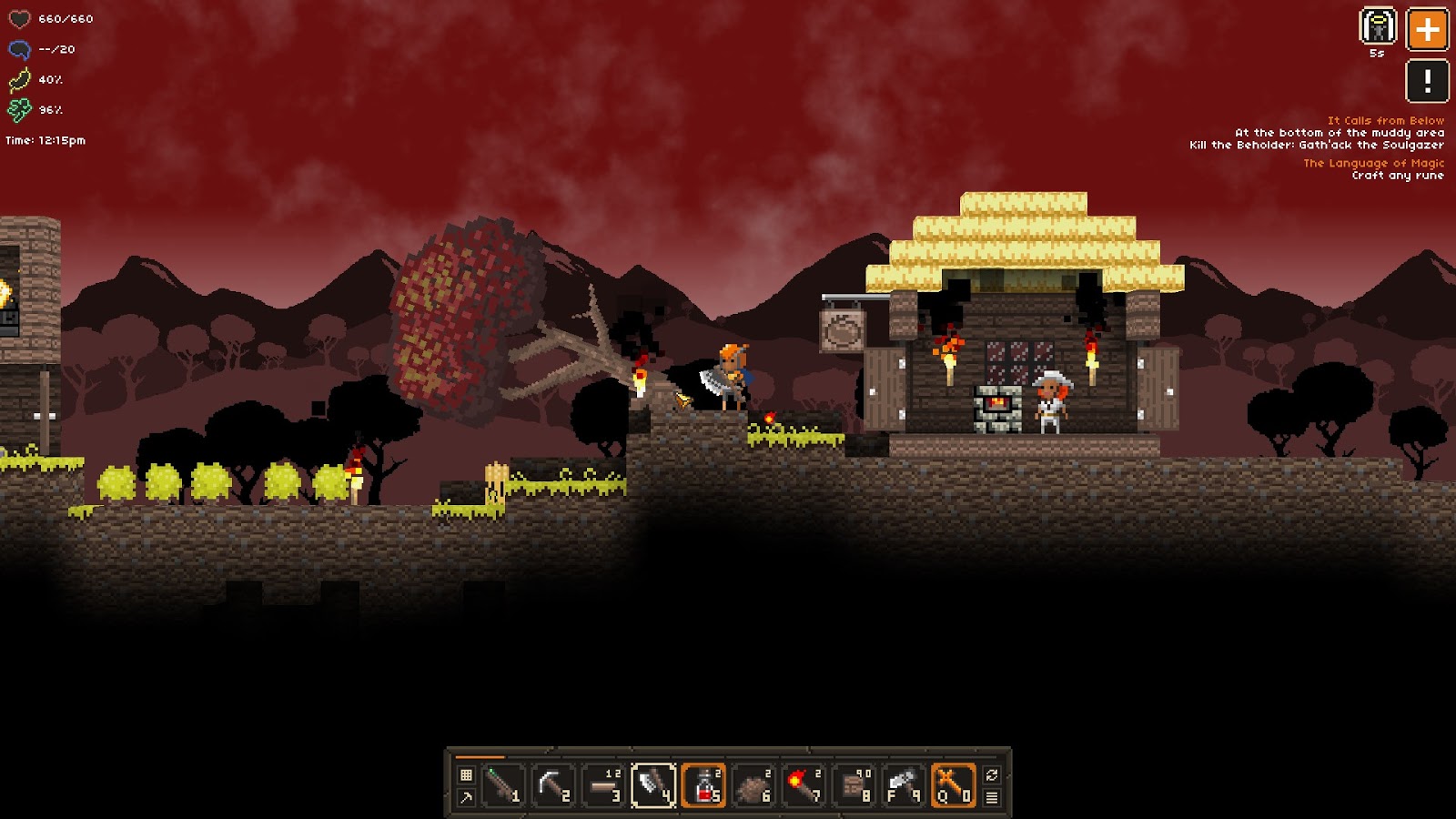
The newest game by Greybeard Games, founded by Diablo 1 and 2 creator David Brevik, is more than a little influenced by the likes of Terraria and Minecraft. Taking the form of a 2D survival game with strong action-RPG elements, the game itself is a charming and suitably dark-fantasy experience, with plenty of satisfying action and compelling, addictive gameplay.

On first glance, It Lurks Below has a lot in common with Terraria. Source: In-game screenshot.

The first thing gamers will notice upon booting up It Lurks Below and dropping into the world is its striking similiarity to the likes of Terraria and Starbound; that much is deliberate, the creator himself describes the game as a tribute to the survival genre. But soon, It Lurks Below’s unique identity begins to stamp itself on the player and they will quickly find themselves addicted to the joy of exploring ever-deeper with ever-bigger guns.

Exploring deeper is rewarding, terrifying and intriguing. Source: In-game screenshot.

There is a sense that It Lurks Below has somehow recaptured the joy of playing the survival genre in its heyday. There is something so addictive from learning the ways the game works, from crafting tools to delving down below to face off against demonic hordes. On top of an impactful combat system that is every bit as exciting as the games for which its creator is famed, It Lurks Below’s survival mechanics become intoxicating, and the player feels a sense of growing more powerful by the second, especially as they get to fire off their growing arsenal into the demons.

Another thing interesting about It Lurks Below is its graphical choices. The colour scheme of the game is undeniably demonic, with plenty of reds and browns. Its pixelated characters are reminiscent of many nostalgia-throwback survival games of Terraria’s ilk, but carries enough of its own personality to set itself apart, being in fact more 8-bit styled than 16 bit. Parallax backgrounds make an appearance, as, interestingly, do voxels; look toward the edges of blocks in It Lurks Below and you will find that they are actually rendered in 3D rather than as 2D sprites. The result is visually striking and pleasing, and does a lot to setting the game apart graphically. If only some item textures stuck out more from the drab backgrounds, as sometimes resources like tough grass can be hard to pick out and right click.
As with any survival game, chopping trees is a major part of It Lurks Below. Source: In-game screenshot.
It Lurks Below may be Terraria-like in its execution of the gameplay, but there is plenty right now to set it apart from other games wishing to cash in on the survival bandwagon. Currently, the biggest thing that stands this game out is its combat; in the game, fighting is done by magic ‘wands’ that are actually closer to guns in appearance and in use. But what is truly satisfying about laying waste to demons in It Lurks Below is the impact of the combat; every shot feels powerful and every hit landed feels strong. There is something so satisfying about the way the bullets smack against an enemy that has seldom been matched in other survival games. Diablo 1 and 2 come to mind here, as the two games brought a combat focus to an RPG genre in a way that felt fresh and visceral, and It Lurks Below attempts to do the same here.

Cutting down trees is exciting, as they now have a real felling animation, unlike many survival contemporaries. Source: In-game screenshot.


Perhaps more typical of the genre is It Lurks Below’s current status as a beta game. Currently in closed beta, it remains to be seen whether the game will open itself up as an Early Access experience or if it will go for a tighter development cycle. Either way, the game is compelling enough to be well worth playing, and will be very much worth keeping a close eye on, especially with its developer’s strong, undeniable pedigree in gaming history. It Lurks Below stands poised to bring renewal to a genre accused of being stagnant, and it is all the more important as a result.

Tuesday, 10 October 2017

Why Shadow of War's Loot Crates are not okay


I was initially very excited for the new Middle-Earth: Shadow of War game coming out. I loved Shadow of Mordor, especially its Nemesis system and its fluid, Arkham Asylum-styled combat. I loved the idea that a sequel was going to come out and that it would iterate on the system in a way that delivered on the initial promise. I can’t wait to fully experience a fleshed out enemy system where I can manipulate an army’s loyalties for my own bidding.

But then I heard about the micro-transactions that will be soiling the game, and I decided that for a full-priced retail product, I’m just not going to buy it. This is because Micro-transactions overall sully the experience and are an anti-consumer practice that ultimately shows the flawed value of AAA videogames.

Firstly, there’s the issue that having micro-transactions, even ones as tiny as cosmetic upgrades or those not required to beat the game, imprint a psychological barrier into the mind of anyone that’s playing the game. Gamers aren’t getting the ‘full experience’, they’re getting something where content was taken out to be sold back to them. Even if they are there purely for cosmetic reasons, micro-transactions have a reputation for being linked with shadier practices. On some level, I will always associate micro-transactions with poor-quality mobile phone games, because this is where the practice was born.

The use of any kind of micro-transaction in a game came from a need for smaller developers to make money out of something where the initial outlay was nowhere near enough to recoup cost, and while this worked for many developers there is no denying that the use of the practice has become synonymous with a kind of ‘dirty’ experience. Any kind of in-game purchase carries with it the weight of Candy Crush.

Then there is the statement that companies are making when they use micro-transactions. When implementing such systems in Shadow of War, WB Games are ultimately saying that as a gamer, your £42 is not enough. That in some way you aren’t paying enough for the privilege of playing their game. They are saying that they value gamers so little that they will ask them to pay for something that should be free. This shows the kind of psyche behind these anti-consumer decisions; ultimately each customer is nothing but a collection of transactions to be exploited and mined through any means necessary, and even if it’s not, if the company tries to convince you that this is not the case because such items are only an added bonus, that they’re not needed, then why at all should you ever consider paying the outlay for a microtransaction if they’re not needed? If they were as small as an added bonus, surely it would be easy to implement cheat codes as a sign of goodwill toward gamers, but no, they’re selling it.

Such a practice may be justified by some by looking to other companies, such as Overwatch. But let me be clear here; just because another game did it does not make the practice okay. I hate that Overwatch, as a full-retail priced game, still has micro-transactions and loot crates. It never was okay in the first place, no matter how great the underlying game is.

All of this would be bad enough, if it was not for the nature of the micro-transactions themselves. When loot crates are implemented with randomised loot, you aren’t paying for an item. You’re paying for a chance at an item. This means that you may not even get what you want from the purchase at all. This means that as a practice it ultimately is no better than gambling. Don’t tell me that any kind of value mindset was considered when this was implemented in Shadow of War, because if it was, we’d have full-sized DLC, and not the shitty consumer practices implemented in the product as it is.

It is scant justification that Shadow of War is too expensive a project to be paid for by full retail price; if so, it is WB that should suffer the punishment for being overzealous on production value, not the consumer. Make better, more efficient decisions. Not only that, but are we really saying that such a massive, hyped and clearly in-demand product that benefits from the huge license power of Tolkien’s Middle-Earth and the gamer goodwill that came from Shadow of Mordor won’t generate enough revenue to meet cost? If not, then it is clearly a failing of the corporation’s production and not in the pricing.

As an aside, does this show that AAA gaming is quickly becoming unsustainable in the modern market? Clearly, the drive for bigger and bigger blockbuster games is top-heavy and expensive and if a company can’t make a profit on a AAA title with any kind of reasonable pricing system in place, then that is surely a problem with the typical practice used in developing AAA games. Perhaps this is a sign that the gaming industry at large, at least the blockbuster one, is showing some fatigue.

Ultimately, when any company makes the decision to engage with microtransactions in their product, they are making a judgement call on how much they value their audience, and how much they value the nature of their product. If they believe that their product is not good enough to stand on its own without a shady, anti-consumer practice powering the gears, then why should we, as gamers, believe that such a product is worth our full retail bucks? If the full RRP of a game isn’t enough, either raise the RRP or look at the costings before passing on shady practices to the customers.


Here, instead WB Games has decided to say that their customers aren’t good enough, and are sullying the name of their franchise to do so. Not only this, they are also lowering the perception of their product and creating a poor brand image. Saying that such transactions are optional only begs the question of why they are included at all, and why should consumers foot the bill by continuing to put up with the shitty practices of a top-heavy industry that is showing signs of bloat and fatigue?

Monday, 31 July 2017

Control the Controller: Rebuttal

Another day, another sad media opinion piece dragging the videogame market through the mud. This time it is the turn of The Star Online, which concludes: ‘Videogames are doing many children great harm. The many children in question constitute a significant number of boys in the up-and-coming generation. For these boys to become authentic men, they need to be rescued. They are not going to rescue themselves.’

One of the better videos on the topic of videogame addiction and the surrounding media hysteria surrounding it is by Extra Credits, shown here. The video is rightfully careful to discriminate addiction from compulsion, and importantly demonstrates why videogame ‘addiction’ as it is termed by the media is largely sensationalism. I think the most important part of the video to pay attention to is that addiction refers to the alteration of brain chemistry to create biological dependence on the substance, an effect commonly seen in truly harmful addictions such as nicotine and alcohol and to a lesser extent, caffeine. Addiction carries with it a horrifying stereotypical image; a violent man with poor hygiene performing desperate acts of crime to further fund his own habits, perhaps. This imagery is often wrong and unfair to those who suffer from addiction, which in itself is one way in which the article and wider media are largely wrong. Not only does such sensationalism harm gamers but it also harms those who suffer from addictions.

On the other hand, Extra Credits reports that videogames rather use the way in which brain chemistry works to create a rewarding system for the player. This is a correct identification, and possibly the main reason that we play videogames as a whole. However, this comes with a lot of issues regarding responsible use of the tools available to videogame developers, something which has sadly been lacking. Many of the big developers instead exploit compelling design in gaming for immoral reasons, in the most cynical of ways. More needs to be done from an industry perspective to tackle immorality in game design, and more pressure from the market will eventually lead to an improvement in this area.

More immediately, however, many of the assertions of the article are downright false and damaging. The way in which the writer paints game compulsion in children is offensive and harmful and not indicative of a healthy approach. This is a tough, negative approach to a problem. Blame is placed squarely on the videogames and they are identified in this article as the singular variable that is causing so much damage. The solution to the problem is to ‘confiscate the controller, smash it, and toss the pieces in a dumpster located at least ten miles from home – and do not ever, under any circumstances, allow one of these nefarious devices back in said household.’

This is, of course, a nuclear option. The complete withdrawal of videogames from a child’s life is an extreme course of action to take. Let’s face it, we live in a time where gaming is more visible than ever, and more accessible than ever. Either through mobile gaming, or through their own social networks, a child is going to be exposed to videogames. To tackle the underlying issue which is toxic videogame playing, a nuclear option is oftentimes going to do more harm than good unless in the most extreme of cases. Granted, where gaming becomes the square, central behavioural issue, some withdrawal of gaming privileges can, in a parenting sense, be a logical move to make. However, this is definitely where the facade of the article’s bias begins to fade; look at the terminology used. Games are described as ‘nefarious’. Evil, cunning things that are out to get you. This is the definite thing that games are not. Games are tools, and it is the misuse of these tools that are causing the problems.

On the other hand, Extra Credits has a great counter-strategy in the positive sense to combat toxic, compulsive gaming in young people. It correctly identifies that in a lot of these cases where videogames have become a harmful element of people’s lives, the main problem is mismanagement. Not just of the videogame as a tool, but a chronic mismanagement of that person’s life, either through a lack of real discipline or parental engagement. This is where I particularly like EC’s approach: it identifies the use of a positive mechanism by which to tackle and encourage videogame behaviour.

Too much is placed on the negative aspect of videogames. They’re addictive, they’re violent, mind-numbing. Not enough is placed on the positive ways in which we can use them. Through a good use of scheduling and the right encouragement and parental framework, games can be just another useful tool by which to raise your child. Instead of taking away, and engaging in destructive activities that only serve to cement one’s dominion over their child, Extra Credits instead encourages positive relationships with games.

Instead of throwing out the controller, pick it up, and use it as a point to engage with your child. Talk to them about games. It’s such an important part of your child’s life, and they would be thrilled to be able to have a meaningful conversation with their role models about it. Learn about gaming and learn about the right and wrong games for your child to play. Use this knowledge to push your children from the toxic parts of gaming into the kind of games that help them grow; the Minecrafts, the Zeldas, the Don’t Starves of the world. Ultimately, I think that Extra Credits approach is a lot more involved and a lot more realistic. We live in a world where videogames exist, and they are protected as free speech and as an art form. Not only that but videogames are a valuable medium that has developed a strong economy but also is a strong learning tool and culture in and of itself. To think that we can destroy people’s engagement with the medium is naive and destructive in and of itself. Instead of treating videogames like the enemy, the public should instead treat it like a tool, just like television and books.

The Star Online’s article may be sensationalism for the sake of clicks, or it may be a genuine piece of opinion. But it most certainly is harmful and encourages exactly the wrong kind of engagement with gaming, coming from a stark misunderstanding of what a videogame is. While there are massive issues underlying the cynical exploitation of videogame mechanisms, particularly in the mobile and microtransaction space, games are a tool that I will always firmly believe is a force for good. Not only that, but I am a strong proponent of the use of positive mechanisms instead of negative, and the use of engagement and knowledge will surely be far more effective in everyday circumstance than the use of force and oppression.

However, if there is an extreme case where videogames are causing genuine harm to a child, then professional help and a measured response is needed. A knee-jerk reaction informed by a sensationalist article will help nobody. Instead, seek professional help to come up with a measured response plan. It may be the case that videogame time for your child should be reduced or limited as much as possible, but the important thing here is developing an individual, measured plan. Just throwing away videogames is an expensive and damaging thing to do and treating them like the enemy is a more harmful plan in itself. Professional help exists and will undoubtedly assist parenting, but ultimately it is down to parenting strategy to decide a child’s fate, not a videogame’s.

Monday, 10 July 2017

Gaming's Online Multiplayer Problems

Playing an online competitive game as a latecomer just downright sucks. It is the gaming equivalent of opening a door to be punched in the face by a boxing glove that was rigged as a trap. Trying to get into any online game after its main hype has passed is a difficult and grindy experience. Many new players will get soul-crushingly destroyed by the hordes of skilled and practiced players who understand the ins and outs of every map and have even begun to peel away at the layers of metagaming.


One of the most prominent example of a game with a severe gap of skill between newcomers and experienced players is Overwatch. It truly is a shame to see that there is a game out there made with so much accessibility in mind to be one of the most harrowing online multiplayer experiences one can face as a newbie. Despite the amazing premise of the game and the wonderful character and charm, it is impossible for me to get into Overwatch because I simply can’t stand how I get destroyed in every match with no hope of a win as a new player.


The biggest problem with gaming’s accessibility is gamers’ general disdain for newbies. Many can relate to the experience of being referred to dismissively as a ‘casual’ or ‘noob’ and treated like a second-class citizen as a result. The ‘git gud’ culture is pervasive throughout all genres of videogames and is a sign of a more toxic attitude behind the scenes of gaming. This is not a sustainable situation and this is precisely the kind of behaviour that turns off non-gamers from the medium. We have created a strange kind of culture where new players are specifically made to feel unwelcome.


While everybody loves to be good at games, and most gamers offer little more than snorts of derision to the lesser-skilled, I believe that this is one of the biggest problems with online gaming and gamer culture to date; a gaming culture that alienates rather than includes. This has caused major problems with how gaming is viewed by outsiders looking in.


On the other hand, there are big problems with marketing a game with accessibility in mind. There is an image of games that cater for ‘casual’ gamers as being of ‘lesser’ quality. In fact, many commenters on more toxic gaming sites will happily deride the more easily accessible games as ‘for casuals’ and will treat such games with disdain and even anger.


A happy balance needs to be struck between maintaining a game’s hardcore appeal but also in allowing more accessibility. Currently, the balance seems to have shifted towards the ‘hardcore’ gamers, with Overwatch and Dark Souls dominating the gaming world, and a typical walled-off mentality to any would-be newcomer to gaming. But if gaming is to continue to grow we need to examine how we are treating our player bases. If we continue to alienate, gaming culture runs the risk of continuing to be alienated by other media cultures as a childish pursuit.


More effort needs to be made to make online competitive gaming a more friendly place for all. We are nowhere near a level where we can call online gaming an all-around ‘good’ experience. Between toxic tryhards and angry trolls, it is difficult to find any online game that hasn’t been tarnished terribly by the toxicity of gamer culture. Perhaps the difficulty of integrating into an online competitive game is the most practical example of how gaming’s community problems are stacking up.


We need more games that will try to level the gap between new and lesser skilled players and the more experienced, hardcore gamers that practice all day long. Perhaps this can be done by better separating the two; so far I have seen an extreme deluge of games where hardcore gamers are placed into the same playlists as new players and often exploit such matchmaking systems to create easy matchups for themselves. It’s clear that matchmaking algorithms as they are today are not sufficient for keeping the skill gap at an even and fair level.


On the other hand, perhaps we also need more games like Mario Kart, where newbies are allowed to feel like they have a chance to win, with powerups and other gameplay difficulties dynamically adjusted to allow the lesser skilled to even the playing field. Hardcore gamers will cry foul at this idea, but perhaps this could be done in conjunction with a ‘hardcore’ multiplayer mode that turns off such adjustment, to appease those that want to play purely through skill, as fair or unfair as that can be.

In any game, there are winners and losers, but the real challenge is making losing fun, or making the losers feel like they had a real chance. Gaming has been far too unforgiving to the losers. In order to help gaming culture continue to mature, and for the medium to continue to grow, we need a shift in thought and a shift in design ideas to allow those of all skill levels to play online games on a relatively even and enjoyable field, such that new and less experienced players can enjoy a gentler introduction to games they’re trying for the first time, and that hardcore gamers can still get that purely-skill based level of eSport that they deserve.